Exercise isn’t about feeling better; it’s about bringing you to baseline...
In an interview with the pioneering professor of Happiness Studies, Tal Ben-Shahar, he was asked what he thought was the most important thing for happiness. I was surprised by his answer.
He said that if he were a therapist, the first thing he’d ask every client is, “Are you exercising?” He explained that it’s not even about exercise making you feel better, so to speak. As humans, we are meant to move. If you’re not exercising regularly, you’re not even at a baseline level for mood, focus, and energy.
This claim is backed up by science. Studies suggest that exercise is as effective as prescription antidepressants. (1) Neuroscience offers an explanation for how exercise improves mood, energy, and brain health (see Wendy Suzuki’s TED Talk).
A final perspective comes from Peter Attia, MD – he is one of the world’s top experts on longevity and human performance. He explains that exercise is the most effective elixir we have for overall health. “Exercise might be the most potent ‘drug’ we have for extending the quality – and perhaps quantity – of our years of life.”
When we think about exercise there are really three main areas to note. If you’re a fitness enthusiast, pro athlete, exercise physiologist, etc. I apologize in advance as I keep this simple.
You want to train mobility (think flexibility, injury prevention, stability, etc.), cardiovascular capacity, and resistance (strength, hypertrophy which means bigger muscles, power, etc.).
So here is a simple guideline. If you do this you’ll be in a pretty high percentile of physical fitness. I want you to (almost) every day break a sweat and/or move heavy things.
The DHS, CDC, and most other physician-informed guidelines suggest 2.5 to 3 hours of moderate-intensity exercise per week as a healthy minimum.
That may sound like a lot, but think: 36 minutes, five days per week, gets you to three hours.
Those sessions should be some combination of moderate cardio where you break a sweat and full body resistance training. Aim for Zone 2 cardio primarily which is about 75% of your max heart rate – you can look up that figure for your age and gender. And aim for about 8 sets per muscle group per week in the 10 or so rep range. These should be pretty hard sets where you approach failure (if you’re physically able to do so safely). Then once every week or two, I suggest VO₂ max cardio, which is just a different sort of cardiovascular training. It is tapping into your maximal heart capacity. VO₂ max, like the sleep data above, is associated with reductions in all-cause mortality. Again, it’s hard to be happy if you’re dead. A good VO₂ max protocol is the “Swedish 4x4,” which is four minutes pushing yourself at 90% of max heart rate, then four minutes of rest, repeated four times.
Lastly, mix in a bit of daily stretching, yoga, or mobility work.
Here are two sample programs, but again, you can keep it simple to start: 5 days per week at 40 minutes each or 3 hours per week total. Move your body: break a sweat and lift heavy things. Follow that as the main objective and suit it to your context, physical abilities, and needs. And of course, consult your physician before beginning a new exercise program.
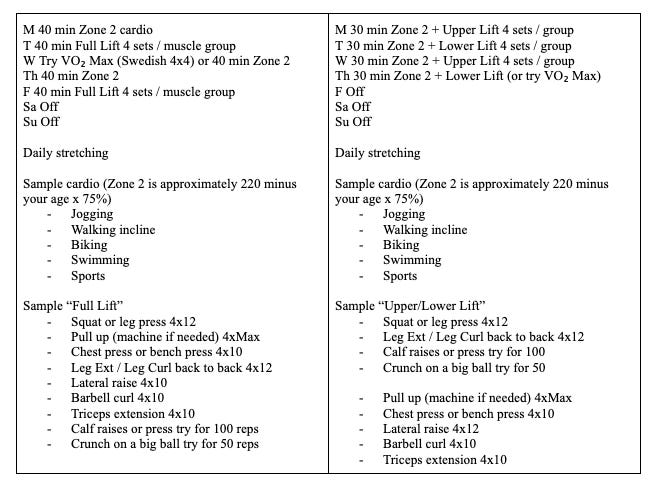
Your ideal program will vary. Consider working with a trainer or physician to develop the right plan for you. And if you want to go above and beyond, you might incorporate heat and cold exposure into this routine, as both sauna use (20–60 minutes per week) and cold exposure (~50°F water for 3–5 minutes) are associated with improved mood and health.
But one more time, let’s keep it real simple: call it three hours or so per week breaking a sweat with cardio and/or lifting heavy things—and once in a while, push your VO₂ max. Or, of course, just start with more than you’re doing now!
Babyak M, Blumenthal JA, Herman S, Khatri P, Doraiswamy M, Moore K, Craighead WE, Baldewicz TT, Krishnan KR. Exercise treatment for major depression: maintenance of therapeutic benefit at 10 months. Psychosom Med. 2000 Sep-Oct;62(5):633-8. doi: 10.1097/00006842-200009000-00006.