


You’ll often hear from me that happiness is learned: it’s not just something that happens to you, but it’s up to you.
Well, how do we effectively pursue, or perhaps cultivate, happiness?
It starts with this (spoiler alert): you’re going to die.
Yes, you.
(Also, can you tell I’ve been working on my writing hooks?)
In all seriousness, I can pretty much guarantee that in the next 100 years, this will be the case.
I start here because I’ve come to believe that acknowledging death — and even contemplating it from time to time — helps you live with far more clarity and intention. In this writing, I’ll explain why, and how it fits into a life operating system that takes about 5-10 minutes a day.
So, why start here?
Let me introduce you to a woman named Bronnie Ware. Around the year 2000, she took a job as a palliative care nurse helping people in their final days of life. Over eight years, she built relationships and had many conversations, seeking to understand the state of mind and wisdom these people had to share.
One day in 2009, she decided to write a blog post about something on her mind. She noticed the same handful of regrets consistently expressed by these people in their final days.
The post went viral, and a few years later, she published her book on the top regrets of the dying. Here they are, in my own words:
I wish I had been true to myself.
I wish I had not worked so much.
I wish I had not lost touch with friends.
I wish I had allowed myself to be happy and to express what I really felt.
Can you see yourself regretting anything similar?
This is a powerful exercise because it helps you identify which traps to avoid and how to start living right now.
That said, research shows we naturally avoid considering our mortality. To that point, a 2019 study had an experiment in which people viewed videos of faces, including their own, morphing into other faces over six seconds. The participants were to press a button when they felt that the face had changed to another person’s. Appearing over the faces were various words with death-related connotations. When one saw his or her own face with a death word, they pressed the button sooner, suggesting that participants wanted to avoid associating death with themselves.
It’s worth overcoming this natural avoidance because this sort of death reflection is step one in a 3-step happiness scorecard process: a “life operating system” so to speak.
Step 1: Imagine
You are time-traveling to yourself in your 80s. From that vantage point, you look back on your life right now. What advice do you have for your current self? What might you regret in terms of the decisions you’re making or how you’re spending your time?
It may help to think about the core components of your life quality, which I define as physical, mental, and relationship health.
Stay in that state of mind as your older self for one more moment. When you look back on the story of your life, what needs to be true for you to feel extremely satisfied with it?
Great, take some notes on this, because you now have a vision.
Step 2: Ground
Ground this vision into your day-to-day life. Here’s how: turn your insights from Step 1 into 5-10 daily questions. Create a scorecard, either on paper or digitally.
On the left, list your 5 to 10 short reflection questions. On the right, create a box where you can score yourself with a simple yes/no or good/bad.
For example: Today, did I spend time on X? Did I do a good job letting go of the little things? Did I train my body? Did I train my mind? Did I do something to nurture a relationship? Did I work on something meaningful? Did I spend too much time distracted? Did I lose my temper?
These can be whatever you want, but they should tie back to the insight you had earlier about what is most important to you.
Now, at the end of each week, you will review that scorecard.
Step 3: Review
Put 15 minutes on your calendar at the end of each week to review how you did.
Here’s a neat discovery I made the other day: there are only five things you can do regarding anything in life. Start, stop, increase, decrease, or sustain (no change).
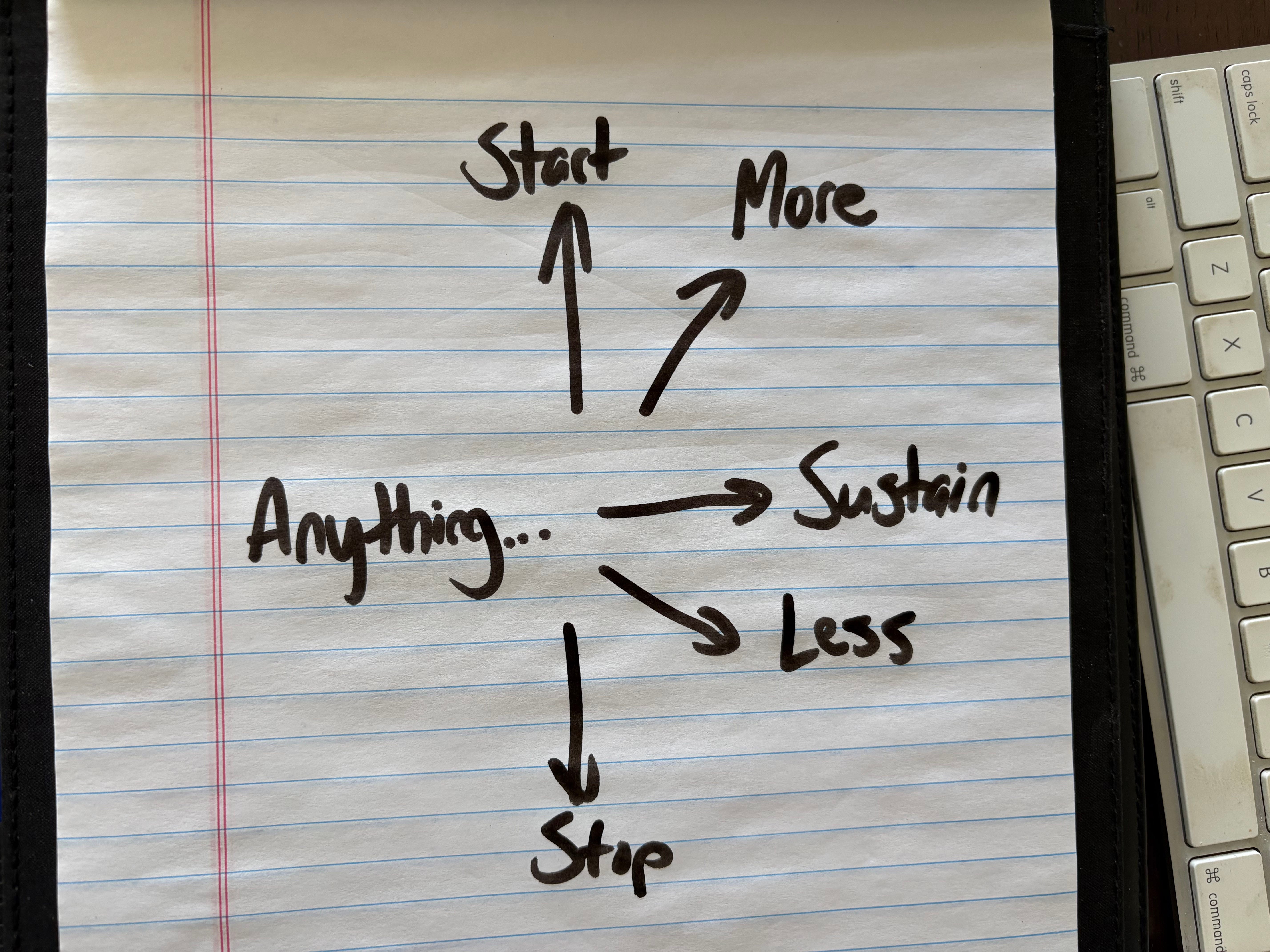
Look back at your scorecard and ask yourself: do I need to start, stop, increase, decrease, or sustain any elements of my life? What do I need to do to be better next week?
Simply repeat this process for the rest of your life...
This system takes your vision down to the ground level of day-to-day life, continually checking and adjusting. Weeks on track turn into months on track, which turn into years on track, which ultimately turns into living your life on purpose — and avoiding Bronnie‘s list of regrets.
Build the life you want one day at a time, and don’t fall off the beam. You won’t be perfect, but you gotta start somewhere.
Imagine. Ground. Review. Repeat.
Your happiness nerd,
Jackson K