While mindfulness in itself is a great thing. And in our discussion of being happy “in” your life mindfulness – awareness – is the foundation for emotional intelligence. And emotional intelligence may just be the key to a better overall balance of positive psychological states…
“If you’re so smart, how can you be so dumb?” – Jackson’s mother, circa 2016
As a young man, I was playing goalkeeper for our soccer team. I got scored on in the last play of the game, and in a moment of anger, I punched the wall as hard as I could.
Of course, the wall learned a very valuable lesson that day about trying to undermine my performance. I, on the other hand, needed a few days. Because after about a week, my hand was still the size of a grapefruit. I ended up going to the doctor, getting three metal rods put in my hand, and spending the rest of the spring in a cast.
Now, if you’ve raised or been around teenage boys (or been one yourself), you know we are a very wise bunch. So, of course, I learned an important lesson about emotional self-control… and that lasted about six months. Not long after getting out of my cast, a series of unfortunate events (mostly centered around me being an idiot) led to my then ex-girlfriend’s new boyfriend showing up at my house at 1 a.m.
We had a short skirmish – and thankfully no one was around to record it – because neither of us had the slightest clue how to fight. Next thing I know, I walk into the house and my left shoulder is stuck up beside my ear. My mother, very graciously, had to drive me to the emergency room in the middle of the night so they could pop my shoulder back into place.
Here’s the interesting part. By all quantitative markers (which can be misleading), I was “smart.” I had a 4.4 GPA, was near the top of my class, had almost perfect test scores, and earned a full academic scholarship.
So what’s going on here?
Well, as my mom asked me after all this – if you’re so smart, how can you be so dumb?
It turns out there are many different types of intelligence. But a key distinction to bear in mind is that IQ is not the same as EQ. There’s the intellectual, analytical kind of intelligence – and then there’s emotional intelligence, which is the ability to assess and manage emotions: both your own and others’.
This construct largely comes from the work of psychologist Daniel Goleman. It starts with awareness. You begin by noticing what’s going on emotionally within yourself and in others. From there comes regulation or management – of yourself and of your relationships. Think of it as recognition and response.
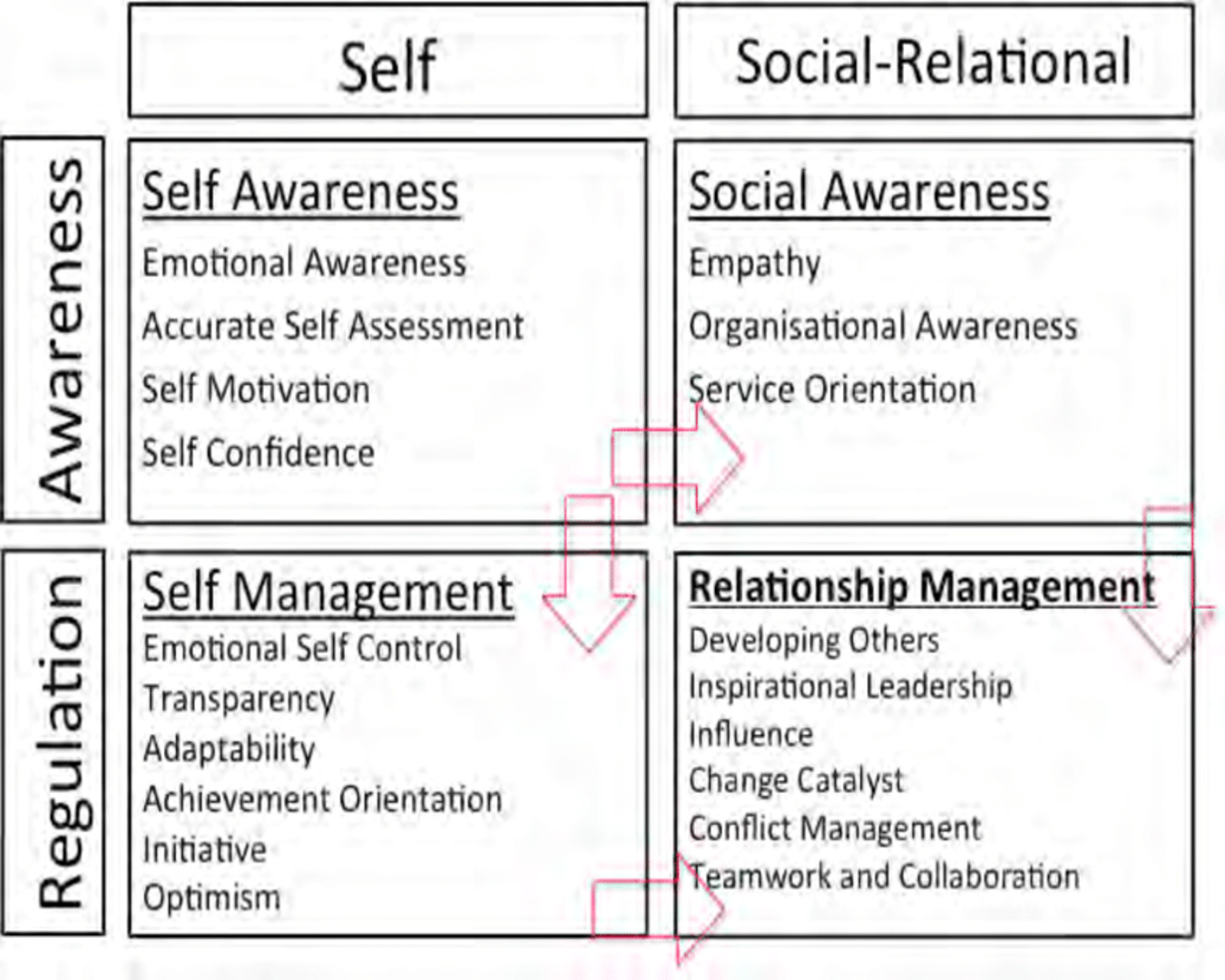
Emotional intelligence can be improved with study and practice. That’s what we’ll explore next.
In other entries, we covered most of that first quadrant: Self-Awareness. As you engage in practices that increase your attentiveness in the present, you naturally develop a greater awareness of your psychological state.
To take this further, you can try journaling or other self-assessments. Simply ask yourself things like: What am I feeling right now? What am I experiencing right now? What emotions or thoughts are present right now?
Labeling these states – with curiosity and without judgment – evokes self-awareness. A helpful mindset here is to identify with the container, not the contents. You are not the “stuff” going on inside your mind; you are the witness, the one observing it.
Try a quick exercise. Say your name to yourself in your mind. Now imagine a pink polar bear.
Can you see it? Can you hear your name?
Here’s the odd part: did you say your name or hear it? Did you think of the bear or see the bear? Who’s actually doing the seeing or hearing?
Self-awareness is about stepping back from the stream of thoughts and emotions and learning to observe them without identifying with them. You can feel emotions fully – this isn’t repression – but from a slightly more spacious place. You identify with awareness itself, not with the passing contents of the mind.
All those thoughts and emotions passing through you are not you – they are just mental formations. You are the container, not the contents.
This isn’t easy, and it can sound abstract at first, but it’s true. There’s a level of consciousness that experiences your thoughts and emotions yet remains distinct from them. With practice, you can relate to your own psychology from that level of awareness, noticing thoughts and feelings arise and pass away. From there, you have more choice in how – or whether – to react.
As Jon Kabat-Zinn likes to ask, “Is your awareness of your anxiety anxious? Is your stress stressed?” You are not these things; these things exist within you.
Practice for Emotional Intelligence: Self-Awareness
Take five minutes privately without distraction. Close your eyes and bring your attention to your mind and body. For 2 minutes practice labeling any thought or emotion or image that arises. Do so without judgment. In your own mind simply say: planning, emails, tiredness, frustration, boredom, anxiety, daydreaming, Sarah, whatever comes up. Just practicing noticing and identifying whatever comes and whatever goes.
For the next 2 minutes reflect on something that makes you upset, angry, or frustrated. Think of that thing and put yourself in that place. Do this and as you do it just notice – how does it feel? Does it have any weight, color, or pressure? Where does it show up in the body? What is the quality, type, pace of thought with it? How does this emotion present itself and what might you call it?
For the last minute reflect on this practice of evoking self-awareness. What did you notice? And how can you bring this into your daily life?
The next quadrant is awareness of others: Social Awareness.
Empathy is the ability to understand and feel what another person is experiencing – not just intellectually but emotionally. In Goleman’s framework, it lives at the intersection of awareness and relationship. To recognize others’ emotions, you must first cultivate awareness.
Empathy isn’t about agreeing with someone or fixing their problems. It’s about being present enough to notice cues, feel what they’re going through, and respond in a way that makes them feel seen.
Empathy is grounded in mindful, active listening – giving someone your full attention while listening to understand, not just to reply. You’re also listening for more than words: for tone, body language, and emotional patterns.
To take this further, focus on curiosity over judgment, and practice both paraphrasing and asking open-ended questions.
Examples:
Exploring a situation: “Can you tell me more about your experience with that?”
Emotional impact: “How do you feel about that?”
Motivation: “What would you like to achieve in this situation?”
Understanding: “What challenges do you see?”
Evoking change: “What are the potential positive or negative consequences of that?”
Here’s a checklist for mindful, active listening:
Take a deep breath as the interaction begins – feel your feet on the floor or hands together to ground yourself.
Bring full attention to the person as if they’re your meditation object.
Listen to understand; ask open-ended questions.
Paraphrase what you hear to confirm understanding.
Listen for emotion and tone, not just words.
Share authentically but hold space for the other person.
Practice for Emotional Intelligence: Social-Relational Awareness
Think of someone you have rapport and trust with who may be open to letting you practice with active listening. Explain to them you’re working on your listening skills. Ask them if they have anything that they’ve been thinking about that they could use some time to talk through or think about (don’t pick the most dramatic difficult problem ever).
Set aside 10 minutes with them. Invite them to discuss it. Start with something like this: “okay I’m going to do my best to really listen to you – what’s on your mind?”
Then implement the above checklist as you go.
At the end, reflect on how it felt and ask them how it felt. What went well and what could you improve in the future?
From this place of awareness we have recognized our own emotion and the emotional context of others. So how do we respond?
Let’s start with the quadrant of Self-Management.
I like this practical framework based on the thinking of scholar and Buddhist monk Matthieu Ricard. Here are three strategies to deal with negative emotions.
Harness
Dissolve
Make into…
I remember it as HDMI…
Harness means using emotion productively – not unleashing it. Emotions are energy. You can direct that energy constructively. Say you’re angry at your partner for showing up late. Instead of snapping, harness it to communicate respectfully: “When you’re late, it makes me feel…” Then sit on it, edit it later, and share calmly if needed.
The same goes for outrage. Destructive if it leads to arguments, but powerful if channeled into volunteering or advocacy.
Dissolve means seeing the emotion for what it is and letting it fade. Label it and watch it dissipate. I once heard of a monk who suffered panic attacks. It wasn’t until he learned to say “Hello, panic” and observe it arise and fall that he found peace. Emotions are like shadows. Once you turn the light on, they lose their power.
Make into means applying an antidote – transforming the emotion by cultivating its opposite.
The antidote to hate is love.
The antidote to anger is peace.
The antidote to fear is courage.
You can shift emotions through both mind (focus) and body (physiology).
Feeling stressed? List ten things you’re grateful for (mind) and fake laugh for sixty seconds (body).
Feeling anxious? Bring attention to sights and sounds around you (mind) and take ten deep breaths (body).
Feeling angry? Watch a funny video (mind) and jump up and down for thirty seconds (body).
You have far more control than you think. If no one’s around, hold a pen between your teeth (forcing a smile), take a deep breath, and do jazz hands for ten seconds. You can’t do that without feeling a little lighter.
Practice for Emotional Intelligence: Self-Management
We all tend to have one or two negative emotions we gravitate towards. I never really get angry or depressed but I often get neurotic stress and what I call “achiever anxiety” to get stuff done. Identify what is your negative emotion “greatest hit”?
Now, what is the opposite of that emotion? There’s no “right answer”. Maybe the opposite of rage is serenity. Maybe the opposite of depressed is excited. Maybe the opposite of anxious is grateful.
What is one physical antidote and one mental antidote you can apply to yourself when you are feeling that state? Example – when I am feeling angry, I will apply serenity by saying a short prayer and relaxing my shoulders. When I am feeling depressed, I will jump up and down for 10 seconds then think of something I’m looking forward to for 20 seconds. When I am feeling anxious, I will list three things I am grateful for and do three long exhalations.
Next time you feel this negative emotion actually stop and apply your antidote. See if you can do it a few times in the next few days and note the impact.
This takes us to the intersection of social-relational and regulation: Relationship Management. The Relationships section of the book dives into this so for the sake of an organizing structure we will not go too deep here. But there is one core idea that we can examine to round out our mastery of emotional intelligence.
You bring the weather.
This is how I summarize the art and science of the relationship management piece. Quite literally, you shape the emotional climate and the felt tone of every interaction you engage in.
Social emotional contagion explains how emotions spread from one person to another, often unconsciously, through mirror neurons. When we observe someone expressing an emotion, our brains activate similar neural patterns, especially in areas tied to empathy and emotion regulation (like the anterior insula and amygdala). This automatic mimicry and synchronization help us “catch” others’ emotional states, aligning our mood and behavior with theirs. It’s a key part of how humans connect and coordinate socially, but it also means that emotional environments are essentially contagious.
Thus, with intention, you can actively shape the weather of that interaction with respect to the emotional context so that it serves you and serves them. If you notice the interaction is overly negative or unproductive, you can shift your emotional posture to try and uplift the mood. Going into an interaction, you can try to generate an internal state that’s maybe 10% more excited or upbeat than you normally would be.
I’m not saying be inauthentic here. Rather, you’re being intentional with the weather you wish to bring to your relationships.
Practice for Emotional Intelligence Relationship-Management
Think ahead to an interaction or meeting you have coming up. What would be the optimal emotional weather for that scenario? As you engage with this person or group, think of being 10% more outgoing, confident, relaxed, stern (whatever you’ve elected is the optimal weather). Do this through changing your body, your speech, and your inner emotional state. Try to bring the weather to this interaction.
Afterwards, take some notes. Did it feel different? Did people react differently? How can you practice this consistently?
We’ve covered a lot in this section and there is still more to come. But if you start with mindfulness and emotional intelligence you have so much power to control your moment to moment experience and psychological state.