


I’ve tried to distill my last 5+ years studying happiness into the shortest “thesis” possible.
This time period includes…
living with Zen monks for four months
creating the world’s first major in happiness
teaching the first course on happiness at the University of Alabama
teaching thousands of people about happiness from elite special forces operators to high schoolers, truck drivers, and lawyers
and taking in 1000s of hours of books, articles, lectures, and courses
Below you’ll find an excerpt and a link to order the book — if the spirit moves you!
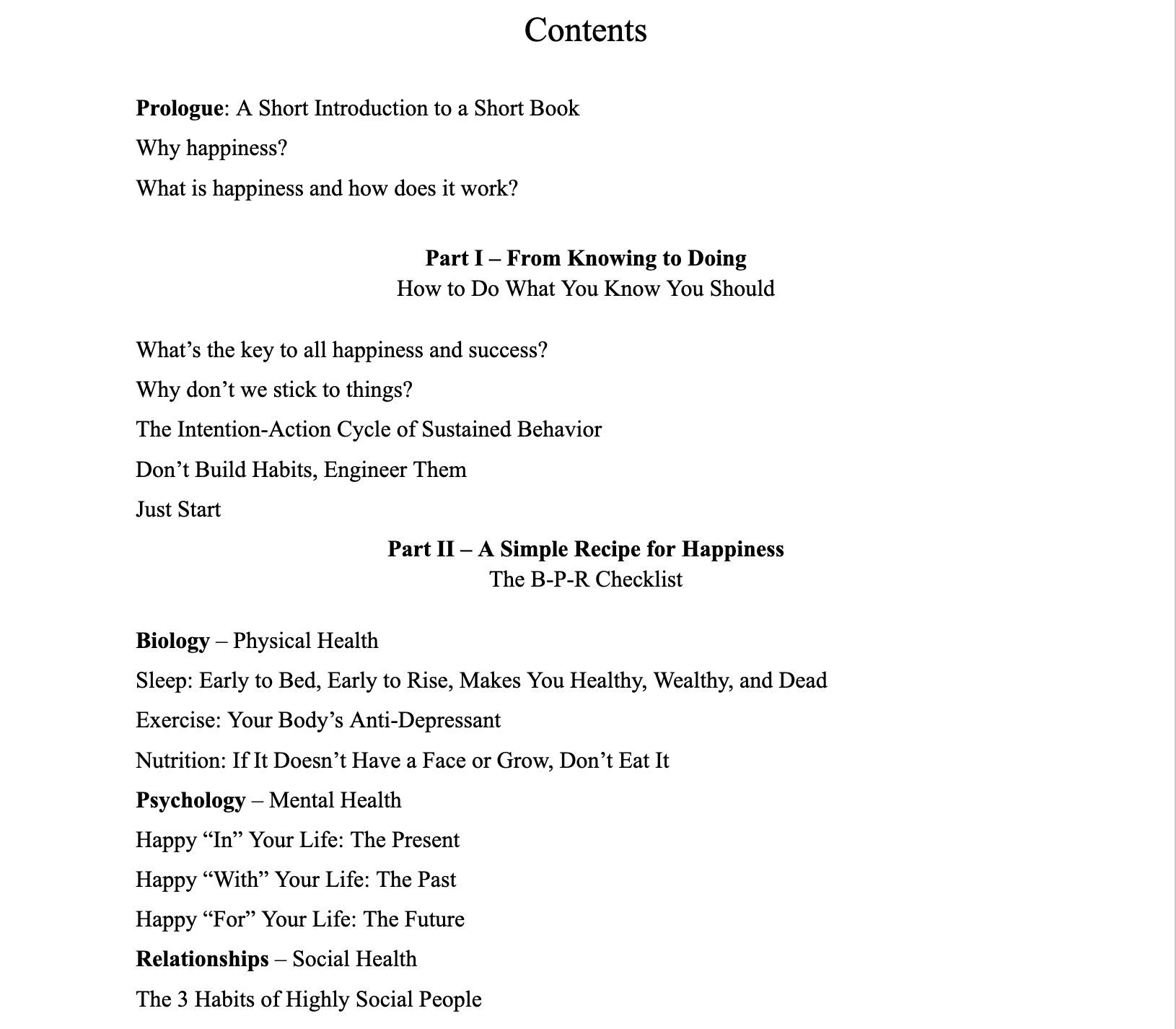

Prologue: A Short Introduction to a Short Book
The world probably doesn’t need another book on happiness, so I decided to write one.
What a brilliant opening line that is! Let me explain. In the last 20 years there has been an explosion of scientific research into happiness and a simultaneous, much much larger, explosion of random hacks’ and gurus’ two cents on happiness.
In fact, there are ~ 20,000 results on Amazon with Happiness as a keyword or part of the title.
What you have here is the world’s shortest book on happiness.
You can look it up in the Guinness Book of World Records and the Global Institute of Research and Publications (GIRP). I’m kidding – GIRP is an institution that I made up and Guinness has more important things to verify like most piercings (Elaine Davidson, lifetime total of 4,225) and fastest time to assemble a Mr. Potato Head while blindfolded (9.27 seconds by Lim Kai Yi).
My intention is to take my last five years of immersive study of happiness and give you the essential “stuff” as it were, in as few words as possible.
This study included creating the world’s first major in Happiness through an interdisciplinary bachelor’s program at the University of Alabama; reading 100s of books and countless other articles and research papers, winning a lightbulb research grant, teaching the first course on happiness in school history, living for four months as a Zen monk, building well-being and culture change programs for the US military, and speaking and consulting on employee happiness for 100s of associations and companies across North America.
This earned me the title of “happiness nerd” by an unassuming Canadian radio host who didn’t know what else to call me. I have not since found a better title.
That said, I don’t plan to invite you to my “cult of the expert” – I consider myself to be a student – a lifelong student of happiness. My invitation is that you’ll join me as a student and take a brief (but thorough) study of life’s most important subject: Happiness.
Let’s start there: why is happiness life’s most important subject?…
____________________________________________________________________________
The Secret to Happiness…
In keeping with the spirit of this book I thought I’d try to give you the secret to happiness in the first couple pages. I came across this story while living at the Zen monastery. If you find this valuable, you may want to read the rest of this book…
A young monk set out to learn the secret of Happiness from the wisest Zen master in the land. He traveled for weeks, crossing mountains and streams, until he reached a great temple.
Upon arriving he found a vibrant scene: monks sweeping the halls, visitors sharing tea and stories, birds singing in the garden, and the fragrance of fresh incense drifting through the air.
The Zen master was speaking calmly with a group of guests, and the young seeker had to wait for three hours before being granted an audience.
When at last he sat before the master, he explained why he had come. The master listened kindly but said that now was not the right moment to teach him about Happiness.
Instead, he handed the seeker a pair of chopsticks. Between them, he delicately placed a single grain of rice.
“Explore the temple and come back in a few hours” said the master. “But I ask one thing of you: do not drop this grain of rice.”
The young seeker bowed and set off, eyes fixed on the chopsticks. He moved carefully along stone paths, through breezeways and halls, up and down the steps, never looking away from the grain of rice. After some time, he returned to the master.
“So,” asked the master, “did you see the rock garden raked just this morning? Did you see the painted scrolls in the hall of ancestors? Did you hear the wind chime in the cedar tree?”
The seeker blushed. He had seen none of these things. His only thought had been not to drop the grain of rice.
“Then go again,” said the master gently. “But this time, notice the world unfolding around you in all its grace and wonder.”
Feeling calmer, the seeker bowed once more and walked again through the temple. This time he noticed the beauty around him—the care in the arrangement of flowers, the slow ripple of waves in the pond, the way the light filtered through old wooden beams. When he returned, his eyes shone with wonder, and he eagerly described what he had seen.
The master smiled, but said, “And the grain of rice?”
Looking down, the seeker saw his chopsticks were empty.
“That,” said the Zen master, “is the only teaching I have for you. The way of Happiness is to experience the beauty of the world in this moment — without ever forgetting the grain of rice between your chopsticks.”
This represents the nonduality of happiness. Can you work towards happiness tomorrow without sacrificing your happiness today? Can you live with the intention to build the life you want but pay attention to the life you have? Can you progress towards the destination that matters most to you: your life tasks – and still savor the journey?
This is the way of Happiness.
____________________________________________________________________________
Order a copy in print, digital, or audio: https://a.co/d/01KDpYTW
